West Virginia, Kentucky, Alabama, Missouri, Tennessee getting investments, 50 new jobs created.
September 29, 2017
Edited by Robert Schoenberger Cars/Light trucks Electric vehicles Manufacturing
Plano, Texas – Toyota plans to invest $373.8 million in five U.S. manufacturing plants to move hybrid powertrain components to this country from Japan.
The investments will include adding new production of hybrid transaxles (hybrid vehicle transmissions) at the Buffalo, West Virginia, manufacturing facility; expanding 2.5L engine capacity at the Georgetown, Kentucky, plant; increasing production of 2.5L cylinder heads at Bodine Aluminum’s Troy, Missouri, plant; and modifying the Bodine Jackson, Tennessee, plant to accommodate production of hybrid transaxle cases and housings and 2.5L engine blocks.
The Huntsville, Alabama, plant will undergo a comprehensive upgrade to enable it to build engines that complement the Toyota New Global Architecture (TNGA), a common platform for several global Toyota cars and trucks.
The 2.5L engines manufactured in Kentucky and transaxles made in West Virginia will be used in hybrid vehicles built in North America such as the Highlander Hybrid manufactured in Princeton, Indiana.
Fifty new jobs will be created because of the investment at the Alabama plant. There will be no net gain of jobs at the Kentucky, West Virginia, or Bodine Aluminum facilities, but these investments will help to ensure the stability of the plants’ employment levels in the future.
Jeff Moore, senior vice president for manufacturing, says the investments “underscore Toyota’s confidence in the capability and global competitiveness of our North American manufacturing.”
Total investment for each plant:
- Toyota Motor Manufacturing Kentucky – $120,960,000
- Bodine Aluminum Jackson, Tennessee – $14,500,000
- Toyota Motor Manufacturing, West Virginia – $115,300,000
- Toyota Motor Manufacturing, Alabama – $106,000,000
- Bodine Aluminum Troy, Missouri – $17,050,000
These projects, and others previously announced, move Toyota nearly halfway ($4.1 billion) toward its commitment to invest $10 billion in the U.S., as announced by Toyota Motor Corporation CEO Akio Toyoda in January 2017.

Group will encourage girls in minority communities to pursue STEM careers.
September 28, 2017
Edited by Robert Schoenberger #WhyMFG Manufacturing People/Facilities
Detroit, Michigan – General Motors has helped launched a Detroit chapter of Black Girls Code (BGC), an Oakland, California-based non-profit that encourages minority girls ages 7 to 17 to get involved with science, technology, engineering, and math (STEM) subjects.
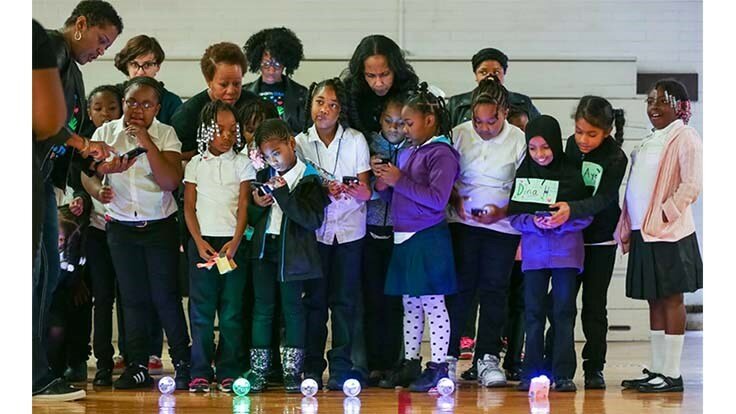
The BGC Detroit chapter will hold a series of hands-on activities at Detroit International Academy for Women (DIA), a Detroit Public Schools Community District school, and TechTown.
STEM students from area colleges and universities will attend a panel discussion with BGC CEO Kimberly Bryant and GM Executive Vice President of Global Manufacturing Alicia Boler Davis, moderated by GM Chairman and CEO Mary Barra.
DIA students in second through sixth grades will work with Black Girls Code and GM employee volunteers to operate the BGC Robot Spiro to help build and race their own toy cars.
DIA students in grades 7 to 12 will hear perspectives from a founding BGC member and young STEM professionals from GM and DTE Energy.
According to the Detroit Regional Chamber, Detroit outpaces the nation in information technology job growth and is expected to continue the pace through 2025. This partnership, announced alongside four other computer science partnerships in June, aims to increase interest in STEM career fields for girls of color. Only 3% of African-American women and less than 1% of Latinas receive degrees in computer science.
“We’re on the forefront of electric and self-driving cars and connectivity that allows our vehicles to communicate with each other – and, with all that innovation, today’s cars have millions of lines of code,” Barra says. “It’s one of the reasons that it’s our mission to help build the next generation of STEM leaders, with an emphasis on expanding opportunities to women and other underrepresented groups.”
Bryant says, “Our regular programming, launching this fall, will lay a foundation to fully engage girls of color in Detroit and is designed to inspire them to continue their paths as future STEM professionals.”
In addition to the programs announced today, GM will have committed more than $10 million by the end of the year to advance and improve STEM education. GM employees have also volunteered more than 48,700 hours to STEM-related nonprofits this year.