Minneapolis, Minnesota – Additive techniques such as 3D printing may not be suitable for building massive commercial trucks, but one producer has been able to use the technology to dramatically improve production speeds.
Volvo Trucks recently slashed turnaround times of assembly line manufacturing tools by more than 94% by incorporating Stratasys additive manufacturing technology at its engine production facility in Lyon, France.
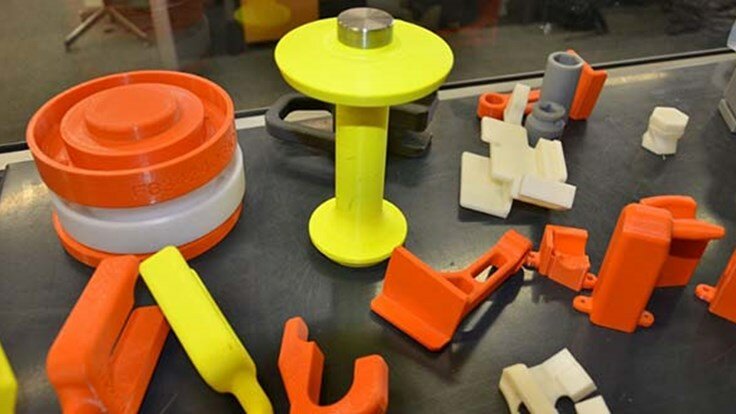
According to Pierre Jenny, manufacturing director at Volvo Trucks, the company has reduced the time taken to design and manufacture certain tools, traditionally produced in metal, to 48 hours from 36 days. Using thermoplastic ABSplus and the Stratasys Fortus 3D Production System to make the tools, Volvo improved the production plant’s overall efficiency and flexibility. Delivery times were upheld, and additive manufacturing saved costs by reducing waste.
Jenny estimates that, where customized or small quantities of tools are required, the all-in cost of 3D printing ABS thermoplastic items is as little as $1.13 per 0.06in3, compared to as much as $113 per 0.06in3 if making the same item from metal.
“Stratasys 3D printing has made an incredible impact to the way we work,” he explains. “The capability to produce a virtually unlimited range of functional tools in such a short timeframe is unprecedented and enables us to be more experimental and inventive to improve production workflow.”
Volvo Trucks purchased its Fortus 3D Production System from Stratasys’ reseller CADvision and within a three month period had 3D printed more than 30 different production tools. These include a range of durable yet lightweight clamps, jigs, supports, and even ergonomically-designed tool holders.
“We’re working in the heavy-industry sector, so reliability is naturally critical. So far every piece that we have 3D printed has proved to be 100% fit-for-purpose,” adds Jean-Marc Robin, technical manager, Volvo Trucks. “This is crucial from a practical aspect, but also instils trust among operators and quashes any traditional notion that everything has to be made from metal in order to function properly.”
Robin adds that developing production tools using additive manufacturing also enables the equipment design team to be far more responsive, while avoiding possible waste in the event of last minute design changes before tools are made.
“The fast and cost-effective nature of additive manufacturing means that we are far less restricted than we were even six months ago, allowing us to constantly improve our processes,” he continues. “We now have operators approaching our 3D print team with individual requests to develop a custom clamp or support tool to assist with a specific production-line issue they might be having. From a time and cost perspective, this is unimaginable with traditional techniques.
“Additionally, in the rare case that the design specifications of a traditionally-manufactured metal tool were inaccurate, the lengthy and costly design and manufacturing process had to begin again. With a 3D printed part, we can simply alter the design specifications and re-3D print the piece in a few hours,” he adds.
Andy Middleton, senior vice president and general manager, Stratasys Europe, Middle East, and Africa, says, “More and more of our customers are adopting additive manufacturing as the first phase to produce jigs and fixtures. As exemplified at Volvo Trucks, using additive manufacturing for tooling and work-holding devices is a reliable solution for increasing efficiency in manufacturing processes. In many cases it is also the only feasible solutions as production by traditional method is limited due to cost- or design-constraints.”
Volvo Trucks’ Lyon engine plant produces various engine types and sizes for the Volvo Group, including Renault Trucks, which the Group bought in 2001.
Source: Stratasys Ltd.