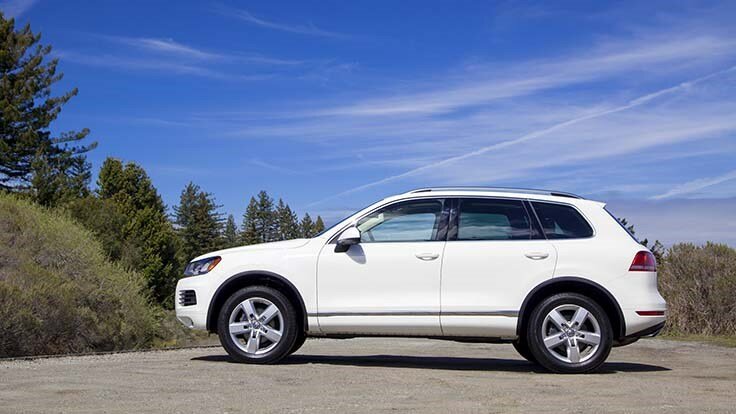
Washington, D.C. – The U.S. Environmental Protection Agency (EPA) has accused Volkswagen of cheating on diesel emissions rules 10,000 sport utility vehicles using 3L engines, potentially opening the automaker up to $375 million in Clean Air Act Fines – on top of the $18.1 billion the automaker faces in fines related to diesel cheating on 388,000 cars using 2L engines.
In a harshly worded report, EPA regulators say that as with the smaller four-cylinder engines, VW’s 3L V-6 diesels use specialized software to produce lower emissions during bench testing but revert to a much dirtier run state – 9x nitrogen oxide (NOx) standards – once tests finish.
In its notice of violation (NOV) regulators say that during testing, engine software in 2014 through 2016 VW Touareg; Porsche Cayenne, and Audi A6 Quattro, A7 Quattro, A8, A8L, and Q5 models move into a “temperature conditioning” mode. In that mode, fuel-injection timing, exhaust gas recirculation rates, and fuel-rail pressure parameters all work to produce low NOx emissions and raise emission temperatures, helping catalysts further clean emissions.
But the NOV says that 22 minutes and 51 seconds later, exactly one second after the EPA’s testing cycle ends, “This software directs the vehicle to cease low NOx temperature conditioning mode…. In this normal mode, the emission control system is immediately less effective.”
EPA officials say the so-called temperature conditioning mode only activates during testing. It is not used on varying temperature conditions in real-world driving.
“VW has once again failed its obligation to comply with the law that protects clean air for all Americans,” says Cynthia Giles, assistant administrator for EPA Enforcement and Compliance Assurance. “All companies should be playing by the same rules. EPA, with our state, and federal partners, will continue to investigate these serious matters, to secure the benefits of the Clean Air Act, ensure a level playing field for responsible businesses, and to ensure consumers get the environmental performance they expect.”
As with the September revelation of diesel cheating on the 2L engines, the penalties could be stiff. Each violation of the Clean Air Act is punishable by a fine of up to $37,500.
In September, when the EPA made its initial accusations against VW’s 2L diesels, company officials quickly admitted to the scheme and apologized for their wrongdoing. With the 3L allegations, however, company officials say they’re innocent.
”The United States Environmental Protection Agency (EPA) informed Volkswagen on Monday that vehicles with V6 TDI engines had a software function which had not been adequately described in the application process,” company officials say. “Volkswagen AG wishes to emphasize that no software has been installed in the 3L V6 diesel power units to alter emissions characteristics in a forbidden manner. Volkswagen will cooperate fully with the EPA clarify this matter in its entirety.”
Update: Late Monday, Porsche issued its response, one that did not immediately claim innocence.
“We are surprised to learn this information. Until this notice, all of our information was that the Porsche Cayenne Diesel is fully compliant,” Porsche officials say. “Porsche Cars North America will cooperate fully with all relevant authorities.”
A key difference between the 2L and 3L diesels is that the larger engines use diesel emissions fluid (DEF) – urea injected into engine cylinders that reduces emissions. VW’s competitors and diesel pickups from Ford, GM, and FCA have for years complied with EPA emissions standards by having two tanks of fluid in their vehicles – one for diesel fuel and one for DEF. The 2L engines were DEF-free, a feat no other automaker had been able to produce and remain emissions compliant in the U.S. Since the scandal, VW officials have said future vehicles would use the fluid. However, if the larger, DEF-using engines still aren’t compliant, winning EPA certification could get tougher.
A week after its first accusations against VW, the EPA began retesting all 2015 and 2016 light-duty diesels sold in the United States, specifically looking for defeat devices. That additional testing led to the 3L allegations. Testing was performed by the EPA’s National Vehicle and Fuel Emissions Laboratory, the California Air Resources Board’s Haagen-Smit Laboratory, and Environment Canada’s River Road Laboratory.
Sources: EPA, Volkswagen