Diversified automotive supplier pickup up global transmissions specialist.
July 17, 2015
Manufacturing Group Cars/Light trucks Manufacturing Powertrain
Aurora, Ontario – Global automotive supplier Magna International Inc. has signed a $1.9 billion agreement to acquire the Getrag Group of Companies, one of the world’s largest suppliers of automo-tive transmissions.
Getrag has an 80-year history in transmissions, offering a range of transmission systems which in-clude manual, automated-manual, dual-clutch, hybrid, and other advanced systems. Magna officials say Getrag’s product line is well-positioned to support current and future automotive powertrain con-figurations.
In particular, Getrag is a leader in the growing market for dual-clutch transmissions (DCTs), which is expected to be one of the highest growth segments globally over the next decade.
In addition to its wholly-owned operations, Getrag has significant joint-venture relationships with Ford, as well as Chinese auto makers Jiangling and Dongfeng. Other Getrag customers include BMW, Daimler, Renault, Volvo, and Great Wall. Including joint-venture locations, Getrag has approximately 13,500 employees and operates 13 manufacturing and 10 engineering centers in nine countries in Eu-rope, Asia and North America.
Magna CEO Don Walker says, “As part of our ongoing product portfolio review, we have identified the expansion of our powertrain business as a strategic priority. Getrag is an excellent fit with this strategy. Getrag is a technology leader in a product area that we believe is well-positioned to benefit from industry trends that are driving increased vehicle fuel-efficiency and reduced emissions. Getrag’s joint venture relationships also provide significant growth potential in China, the world’s largest auto-motive market and the fastest growing market for DCTs. Lastly, Getrag has a highly capable and expe-rienced workforce, including deep powertrain engineering expertise.”
The transaction is expected to close near the end of 2015, subject to a number of conditions in-cluding obtaining all necessary regulatory approvals.
Mihir Kotecha, CEO of GETRAG, says, “Getrag will join forces with a Top 5 global automotive sup-plier, transforming its business to a whole new level. Magna is acquiring a well-positioned company that has significantly increased its turnover since 2009 and invested $1.1 billion into facilities and global expansion during the past decade.”
Sources: Magna International, Getrag
8-speed, 9-speed transmissions supported with friction plates, torque converters.
July 17, 2015
Manufacturing Group Cars/Light trucks Design Manufacturing Powertrain
Auburn Hills, Michigan – BorgWarner is supplying wet friction technology for ZF’s new 8- and 9-speed automatic transmissions. The 8-speed transmission features BorgWarner’s multi-segment friction plates with intricate groove designs, and the torque converter for the 9-speed transmission utiliz-es a piston plate with BorgWarner proprietary friction material.
For several years, BorgWarner has manufactured friction plates in Heidelberg, Germany, supporting ZF’s production of 8-speed transmissions in Germany. Friction technologies for both transmissions are now also produced at BorgWarner’s plant in Bellwood, Illinois, locally supporting ZF’s manufacturing facilities in South Carolina and Mexico.
Robin Kendrick, president and general manager of BorgWarner Transmission Systems, says, “Our advanced processing capabilities allow unmatched design flexibility for outstanding performance while optimizing material utilization for lower cost. We are pleased to expand our long relationship with ZF with localized production in North America.”
For ZF’s 8-speed transmission, BorgWarner’s multi-segment wet friction plate technology features full-depth grooves between segments of friction material to increase oil flow, improve cooling, and prolong clutch life. Using advanced production techniques, grooves can be molded and/or cut into the friction material to disperse heat during engagement, reduce drag, and improve shift feel. Fuel econ-omy is also improved by reductions in spin loss. Unlike traditional manufacturing techniques that cut a full ring of friction material, BorgWarner’s multi-segment process uses smaller sections to significantly reduce material waste.
For the torque converter with ZF’s 9-speed transmission, BorgWarner’s friction material delivers increased power density and thermal capacity for superior launch control. The proprietary materials reduce drag and resist extreme heat to enhance shift feel with less noise, vibration, and harshness (NVH).
Source: BorgWarner

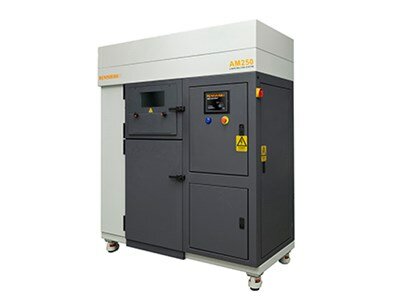
Key features include variable powder delivery, ultra low oxygen content in the build atmosphere, and a safe-change filter system.
July 17, 2015
Manufacturing Group 3D/Additive/Alternative Manufacturing
Hoffman Estates, Illinois – The Renishaw AM250’s laser melting additive-metal manufacturing process is capable of producing fully dense metal parts direct from 3D CAD data using a high-powered fiber laser. Parts are built layer by layer, in thicknesses ranging from 20µm to 100µm, using a range of fine metal powders that are fully melted in a tightly controlled atmosphere.
The current range of machines utilizes a third-generation design representing state-of-the-art manufacturing technology. Key features include variable powder delivery, ultra low oxygen content in the build atmosphere, and an unparalleled safe-change filter system to minimize user contact with materials.
The AM250 features vacuum technology and low gas consumption. It utilizes machine tool engineering in design, operation, and serviceability, emphasizing ruggedness, and ease of operation. The touch-screen operator interface includes menu options for machine preparation and cleaning. Consumable costs are minimized through features such as the soft re-coater blade that can be rotated several times before replacement, use of low-cost filter elements, and low gas consumption – all of which improve system reliability and cost of ownership.
The AM250 system processes a wide variety of materials, including 316L and 17-4PH SS, H13 tool steel, aluminum Al-Si-12, titanium CP, Ti-6Al-4V and 7Nb, cobalt-chrome (ASTM75), and Inconel 718 and 625. The system is designed for rapid material changeover, with a removable hopper – particularly useful for materials development or use of a range of materials. To enhance productivity, a valve interlock allows addition of extra powder while the process is running. Safe processing of reactive materials, such as titanium and aluminum, is ensured with features such as a gas knife that clears away reactive, sooty emissions, and a heated build plate.
The AM250 provides a 250mm x 250mm x 300mm (X-Y-Z) work envelope, with Z-axis extendable to 360mm. The build rate is 5cm3 to 20cm3 per hour, dependent on the material, part density and geometry. The system is available with a 200 or 400 W laser and features a fully welded vacuum chamber, enabling low-pressure evacuation followed by a recharge with high purity argon gas. Gas consumption, after the initial chamber flood, is extremely low, and allows operation at oxygen concentrations below 50ppm – crucial when processing reactive materials, and contributing significantly to material integrity and mechanical performance.
All file preparation is completed off-line through a choice of interface, either Marcam Autofab softwareor Materialise Magics. Once complete, the build file is uploaded to the machine via a secure network or direct connection. Product traceability has been improved by the addition of process data and event logging as standard, with various additional process control options on request.
Source: Renishaw Inc.

Share your love for the best car, truck, or piece of power equipment you’ve owned.
July 17, 2015
By Robert Schoenberger Cars/Light trucks Design Manufacturing
Cleveland, Ohio – Most people who design and build cars, trucks, and off-highway equipment have one vehicle that they really loved. Maybe it’s the car you wanted to drive in high school but couldn’t afford until your kids graduated and moved out. Maybe it’s the classic tractor that your family has managed to keep running for decades. Maybe it’s a low cab-forward medium duty truck that kept going, maintenance free, allowing a business to succeed in tough times.
At Today’s Motor Vehicles, we want to hear about those vehicles. In our new MY FAVORITE RIDE feature, we will highlight one vehicle in each issue of the magazine, sharing the stories of great machines and why they’re special to their owners.
To share your stories, visit www.TodaysMotorVehicles.com/MyFavoriteRide.aspx.
In the spirit of talking about favorite rides, here’s a little about mine.
1963 Volvo P1800
Specs
- 108hp 1.8L inline four-cylinder engine
- Four-speed manual transmission
- 2,491 lb weight
How long have you been involved in motor vehicle design/manufacturing? I’ve been writing about automotive production for 16 years.
Why do/did you love your favorite ride? My father bought his 1963 P1800 when he was in his 20s, no doubt inspired by Roger Moore’s use of the tiny sports coupe in The Saint (the photo is of Roger Moore, not my father). By the time I was born, the car already had nearly a decade’s worth of miles on it, but it was still cool. When all of my friends’ parents showed up to events in vans or sedans, my dad would show up with a car that had mini tailfins and smelled like aged leather.
All of my memories of the car have to do with how manual everything was — from the transmission to the windows. The wind-diverting side windows had these great chrome buttons that you’d have to press really hard (well, really hard for a five-year-old at least) to get them to swivel open.
The car looked faster than it really was, and my father hung onto it well past its sell-by date, but I can understand why he didn’t want to let it go. It had personality and style.
What happened to the car? About 20 years after buying the car, the clutch on the four-speed manual transmission failed. My dad had performed dozens of major repairs to keep the car running, but he realized he was fighting a losing battle against obsolescence. No domestic suppliers stocked clutches for 20-year-old Volvos, and he was going to have to order the new one from Sweden. So, he sold the car to a collector who wanted a classic show car, not a daily driver.
Source: Today’s Motor Vehicles
MCI to supply 772 45-foot coaches by 2022.
July 16, 2015
Manufacturing Group Commercial vehicles Design Manufacturing
Des Plaines, Illinois – In one of the largest contracts between NJ TRANSIT and Motor Coach Industries, New Jersey’s public transportation board of directors has authorized the purchase of 772 fully featured MCI 45-foot Commuter Coaches.
In the latest equipment purchase in a 33-year relationship between NJ TRANSIT and MCI, the $395 million order for clean diesel, cruiser-style coaches will offer NJ TRANSIT riders three-point seatbelts, forward-facing seating for 57 passengers, as well as individual airflow controls and reading lights. The six-year delivery schedule for the new Commuter Coaches will begin in 2016.
This latest order between MCI and NJ TRANSIT will replace existing MCI coaches in New Jersey’s fleet. MCI has delivered over 2,000 Commuter Coaches to the agency since 1982. NJ TRANSIT was one of the first public transit operators to use the MCI Commuter Coach to reach outlying city and expanding suburban areas.
NJ TRANSIT will use this order to replace older 2000-2008 models, many with more than 500,000 miles. Specifically, they’ll replace 235 45-foot and 360 40-foot MCI coaches operated by NJ TRANSIT, and 177 45-foot MCI coaches operated by private carriers contracting with the agency.
NJ TRANSIT estimates the new MCI Commuter Coaches will allow the agency to boost seating capacity by 6%.
Rick Heller, MCI president and CEO, says “Our Commuter Coach has been the mainstay in its express service capabilities for decades. Today’s announcement for 772 additional vehicles marks another milestone in an important customer relationship centered on coach performance and innovation.”
MCI won its first contract with NJ TRANSIT in 1982 for 700 MC-9 cruiser buses, purchasing another 415 in 1987. In 2000, the agency gave MCI the biggest public transit order in North American bus-industry history at the time with a 1,400- vehicle purchase.
NJ TRANSIT was also the first U.S. public transit agency to purchase new-model compressed natural gas (CNG) MCI Commuter Coaches, starting with a 50-coach order as part of a 1999 pilot program and adding 27 more units the following year. It recently replaced those inaugural models with 177 CNG MCI Commuter Coaches delivered in 2014 and 2015.
Source: Motor Coach Industries