With the August 2021 release of ISO 10360-10:2021, laser tracker end-users can now test their instruments in the field with a simplified, internationally approved ISO process—in under 30 minutes.
“Laser trackers and laser radars are mechanical systems that rely on the relative positions of components within the instrument,” said Mark Meuret, Brunson Instrument Company’s Director of Engineering. “These sensitive and highly accurate components can be thrown off, creating misalignment and geometric error sources,” he added.
 Shipping an instrument, wear and tear from frequent usage, environmental hardships, multiple end-users, or simply the age of the instrument can create internal misalignments that degrade measurement accuracy.
“This new ISO procedure is about empowering metrologists, letting them easily check their trackers in the field and maintain confidence in their precision measurement processes,” Meuret added.
Brunson Instrument Co. initially offered the KinAiry Laser Tracker Field Testing Solution based on the NIST IR-8016 test, and the company will soon update the KinAiry software process to accommodate the new ISO procedure.
“Brunson has been involved in laser tracker field testing from very early on,” said Meuret. “And applaud ISO for recognizing this vital need for end-users to maintain confidence in their laser tracker performance,” he added.
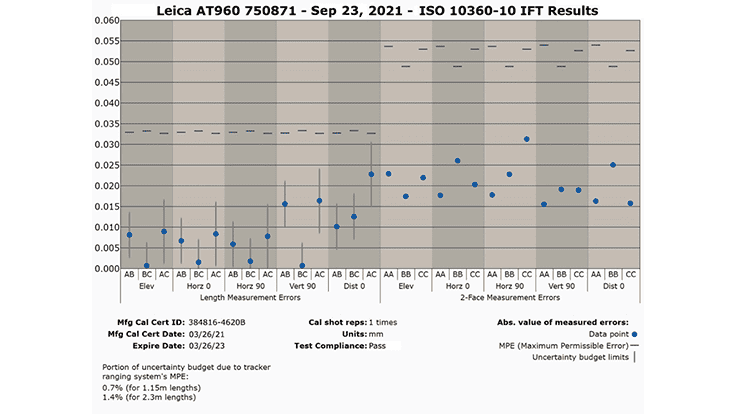
The KinAiry system features hardware—a 2.3-meter reference bar—that is custom-tailored to the precision requirements of the ISO interim field test. The three-piece, easily transportable 2.3-meter reference bar is kinematically mounted at its airy points to provide the required stability. KinAiry software guides the user through the process, which results in a graph that portrays tracker conformance to manufacturers’ specifications.
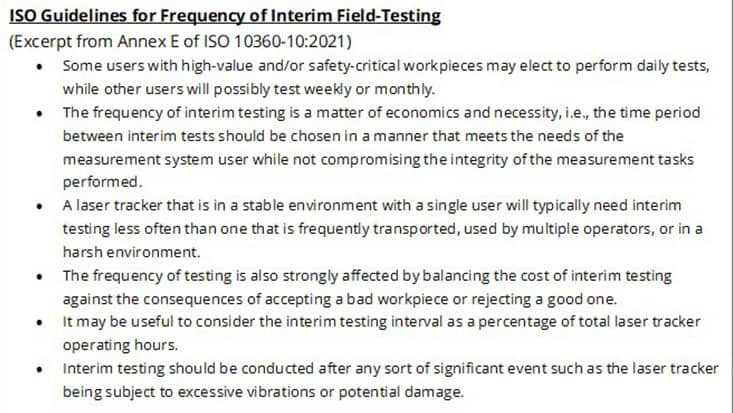
Diminished accuracy can become a metrologist’s worst nightmare. It can lead to unsatisfied customers, time-consuming research to validate past performance data, costly re-work, instrument down-time and, potentially, mission-failure. How frequently should an end-user conduct an interim field test? Below is an excerpt of ISO’s recommendations for tracker testing intervals.